
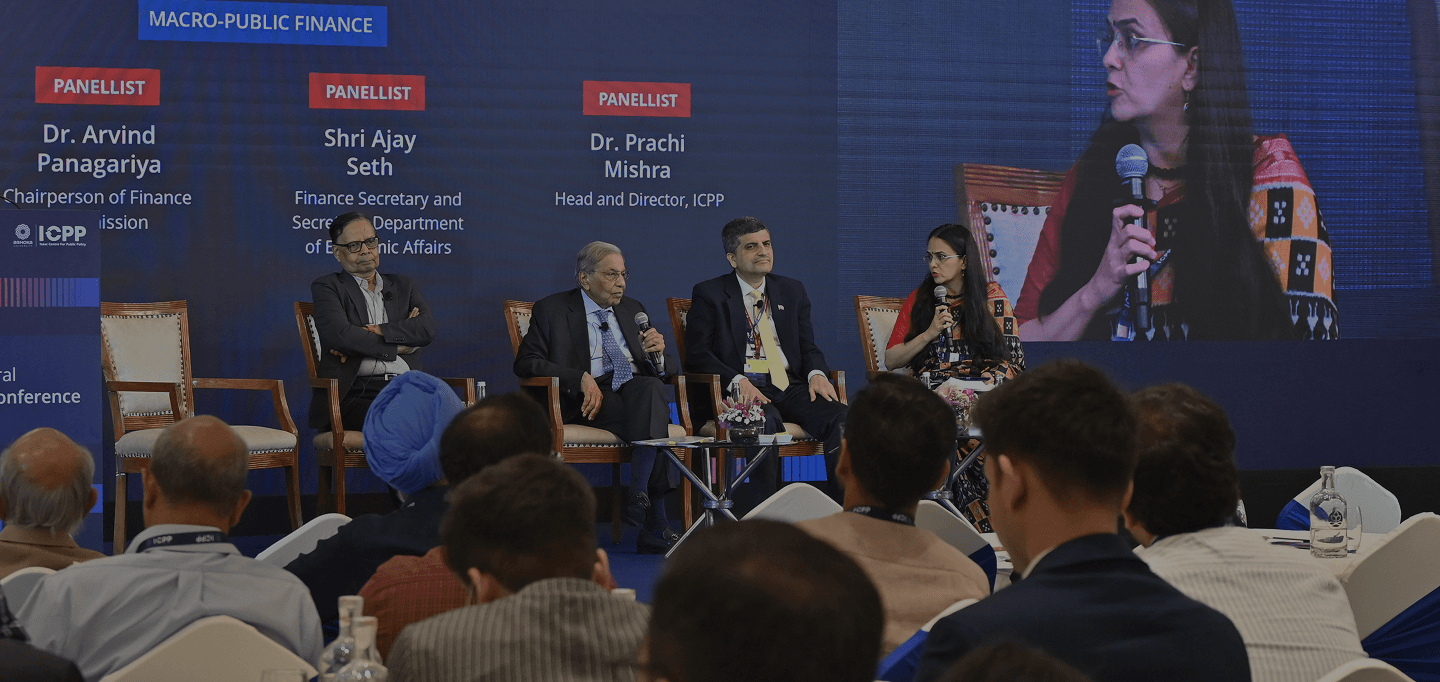
About the talk:
Part 1: Sashakt Bihar
Dr. Mishra presented ICPP findings showing Bihar's per capita income at approximately one-third of the national average, with the divergence either constant or widened over two decades. Bihar nonetheless recorded 8.64% real GDP growth in FY25 (vs. 6.50% nationally)
ICPP proposed a three-engine growth strategy: agro-industrialisation through geographical clustering (litchi processing in Muzaffarpur, maize-based feed in north-east Bihar, makhana parks in Madhubani–Darbhanga, sugarcane-ethanol corridor); tourism, where Bihar contributes just 2% of GSDP against 5% nationally despite the globally significant Buddhist circuit at Bodh Gaya; and GCCs, positioning Bihar as a domestic outsourcing hub for Indian tech firms seeking cost-efficient satellite operations.
Chief Secretary Pratyaya Amrit affirmed alignment with ICPP's framework and added a fourth pillar - urban development. He underscored Bihar's demographic weight (1 in 12 Indians, average age 28, 58 % under 25) and noted the state has moved from a turnaround phase to an aspirational growth phase.
Invest Bihar is being designed with the CM integral to the campaign and the private sector at its core. Ashish Dhawan flagged the contrast between Bihar's ~2,000 factories and UP's ~32,000, pressing on how Bihar would kickstart its industrial engine.
Part 2: States as Growth Engines
Telangana: Rose from 4.1 % of the national economy at formation (2014) to 3rd in per capita income by 2025–26 (behind only Goa and Sikkim), with national GDP share growing to 5%. Three drivers: relentless capex, policy and tenure continuity (Rao cited 14 budgets across 11.5 years as Finance Secretary), and cross-government continuity — the single-window TG-iPASS was retained by the successor government. Unlimited FSI in Hyderabad enabled extraordinary densification; Rangareddy now records India's highest per-capita income at ₹13.5 lakh. Hosts onethird of global vaccine manufacturing.
Madhya Pradesh: Three pillars — sustainable industrial growth, next-gen agriculture with value addition, and breakout services growth. Within 15 months of the Feb 2025 Global Investors' Summit, ~₹9 lakh crore in investment intentions recorded and ₹2.65 lakh crore in manufacturing investments grounded. The e-CORI single-window platform offers 3D-mapped land parcels visible online globally, enabling allotment without a physical visit. As India's tiger and leopard state with nine reserves, MP appeared in the WSJ's 50 best places to visit in 2025; a PPP helicopter service connects Indore, Ujjain and Omkareshwar alongside 600 operational tribal homestays.
Uttar Pradesh: 34 sector-specific policies have generated ₹55 lakh crore in MOUs, of which ₹18 lakh crore is grounded and ₹10 lakh crore operationally active, with 4,300 new factory additions per year. Six new expressways, 15 operational airports, and five international airports under development including Jewar (Asia's largest). UP now has India's largest total budget at ₹9 lakh crore and the largest capital budget.
Punjab: Pending regulatory applications cut from 8,000–8,500 to fewer than 100 (98 %+ reduction); incentive delivery up from ₹60–80 crore/year to over ₹700 crore in 2025–26; grounded investments doubled year-on-year. Greater Mohali positioned around four sub-sectors: semiconductor hub (leveraging India's only government fab), aerospace/defence/drones, education hub, and medical tourism for the Punjabi diaspora. Existing MSME clusters in Ludhiana, Jalandhar and Amritsar being connected to anchor customers like HAL and BrahMos. Bansal was direct that agricultural diversification remains the unfinished challenge — the MSP and procurement system is a binding constraint requiring national-level resolution.
Subscribe to our newsletter
Subscribe to our newsletter
©2024-25 Isaac Centre for Public Policy