icpp-logo
icpp-logo
Home
ICPP Annual Growth Conference

ICPP Annual Growth Conference

The ICPP Annual Growth Conference brings together senior policymakers, leading academics, private sector experts, and civil society leaders for a dialogue on India's growth strategy.

01 May, 2026 - 02 May, 2026

New Delhi, India

Overview 

The Isaac Centre for Public Policy (ICPP) hosted its 2nd Annual Growth Conference on 1st and 2nd May 2026 at the Taj Mahal Hotel, New Delhi. The two-day event brought together over 300 participants; policymakers, economists, regulators, parliamentarians, and industry leaders, to deliberate on India's medium-term growth and development priorities. The conference featured an Inaugural Fireside Chat with Shri Pema Khandu, Chief Minister, Government of Arunachal Pradesh and a Keynote Address from Dr. V. Anantha Nageswaran, Chief Economic Advisor to the Government of India. It also featured State Chief Secretaries , parliamentary spotlight sessions, and policy panel discussions spanning ICPP's key priority areas: Macroeconomics, Regulation, International Trade, Employment, and Agriculture.

Vector

Key 
Sessions 

Closing Keynote: Dr. V. Anantha Nageswaran, Chief Economic Advisor, Government of India

Speakers: K P Krishnan ( Member of Advisory Board, Distinguished Fellow, ICPP)
  • Dr Nageswaran's address covered the macroeconomic implications of the West Asia crisis, India's trade and competitiveness picture, and the strategic buffers the country needs to build. The current account deficit could widen from around 1% to above 2% of GDP, with lower remittances and higher commodity costs compressing the cushion. 

  • On FDI, he argued India is "a victim of its own success," with easier entry-exit rules meaning investors repatriate freely and compress net FDI even as gross inflows remain healthy. On the geopolitical landscape, he identified three structural shifts that will outlast any political cycle: G2 consolidation between the US and China forcing middle powers to recalibrate; fracture in the Western alliance creating both risks and openings; and the middle-power squeeze requiring India to hedge and build flexible coalitions. 

  • China Shock 2.0 is not cheap consumer goods, it is EVs, batteries, solar, and semiconductors, backed by export controls on 29 critical minerals 

  • India's REER has corrected after years of overvaluation; UK FTA signed, EU deal expected by early 2027; total exports including services hit a record $825 billion in 2025 

  • Private investment remains subdued because too much national income accrues to capital and too little to labour, keeping demand soft 

  • QCOs ballooned from ~70 in 2016 to nearly 790 by 2025; now government has revoked over 60 selective deregulation easing inputs costs for downstream manufacturers and exporters. 

Special Spotlight: Sashakt States, Viksit Bharat - Part 1 & Part 2

Speakers: Pratyaya Amrit ( Chief Secretary, Government of Bihar), Dr. Prachi Mishra ( Dean, Ashoka School of Economics and Finance (RJSEF); Director and Head, Ashoka Isaac Centre for Public Policy (ICPP); Professor of Economics, Ashoka University), Shri K. Ramakrishna Rao ( Chief Secretary, Government of Telangana), Shri Anurag Jain ( Chief Secretary, Government of Madhya Pradesh), Shri Awanish Kumar Awasthi ( Adviser to the Chief Minister, Government of Uttar Pradesh), Smt. Seema Bansal ( Vice-Chairperson, Punjab Development Commission)

About the talk:

Part 1: Sashakt Bihar

  • Dr. Mishra presented ICPP findings showing Bihar's per capita income at approximately one-third of the national average, with the divergence either constant or widened over two decades. Bihar nonetheless recorded 8.64% real GDP growth in FY25 (vs. 6.50% nationally) 

  • ICPP proposed a three-engine growth strategy: agro-industrialisation through geographical clustering (litchi processing in Muzaffarpur, maize-based feed in north-east Bihar, makhana parks in Madhubani–Darbhanga, sugarcane-ethanol corridor); tourism, where Bihar contributes just 2% of GSDP against 5% nationally despite the globally significant Buddhist circuit at Bodh Gaya; and GCCs, positioning Bihar as a domestic outsourcing hub for Indian tech firms seeking cost-efficient satellite operations. 

  • Chief Secretary Pratyaya Amrit affirmed alignment with ICPP's framework and added a fourth pillar - urban development. He underscored Bihar's demographic weight (1 in 12 Indians, average age 28, 58 % under 25) and noted the state has moved from a turnaround phase to an aspirational growth phase. 

  • Invest Bihar is being designed with the CM integral to the campaign and the private sector at its core. Ashish Dhawan flagged the contrast between Bihar's ~2,000 factories and UP's ~32,000, pressing on how Bihar would kickstart its industrial engine.

Part 2: States as Growth Engines

  • Telangana: Rose from 4.1 % of the national economy at formation (2014) to 3rd in per capita income by 2025–26 (behind only Goa and Sikkim), with national GDP share growing to 5%. Three drivers: relentless capex, policy and tenure continuity (Rao cited 14 budgets across 11.5 years as Finance Secretary), and cross-government continuity — the single-window TG-iPASS was retained by the successor government. Unlimited FSI in Hyderabad enabled extraordinary densification; Rangareddy now records India's highest per-capita income at ₹13.5 lakh. Hosts onethird of global vaccine manufacturing. 

  • Madhya Pradesh: Three pillars — sustainable industrial growth, next-gen agriculture with value addition, and breakout services growth. Within 15 months of the Feb 2025 Global Investors' Summit, ~₹9 lakh crore in investment intentions recorded and ₹2.65 lakh crore in manufacturing investments grounded. The e-CORI single-window platform offers 3D-mapped land parcels visible online globally, enabling allotment without a physical visit. As India's tiger and leopard state with nine reserves, MP appeared in the WSJ's 50 best places to visit in 2025; a PPP helicopter service connects Indore, Ujjain and Omkareshwar alongside 600 operational tribal homestays.

  • Uttar Pradesh: 34 sector-specific policies have generated ₹55 lakh crore in MOUs, of which ₹18 lakh crore is grounded and ₹10 lakh crore operationally active, with 4,300 new factory additions per year. Six new expressways, 15 operational airports, and five international airports under development including Jewar (Asia's largest). UP now has India's largest total budget at ₹9 lakh crore and the largest capital budget. 

  • Punjab: Pending regulatory applications cut from 8,000–8,500 to fewer than 100 (98 %+ reduction); incentive delivery up from ₹60–80 crore/year to over ₹700 crore in 2025–26; grounded investments doubled year-on-year. Greater Mohali positioned around four sub-sectors: semiconductor hub (leveraging India's only government fab), aerospace/defence/drones, education hub, and medical tourism for the Punjabi diaspora. Existing MSME clusters in Ludhiana, Jalandhar and Amritsar being connected to anchor customers like HAL and BrahMos. Bansal was direct that agricultural diversification remains the unfinished challenge — the MSP and procurement system is a binding constraint requiring national-level resolution.

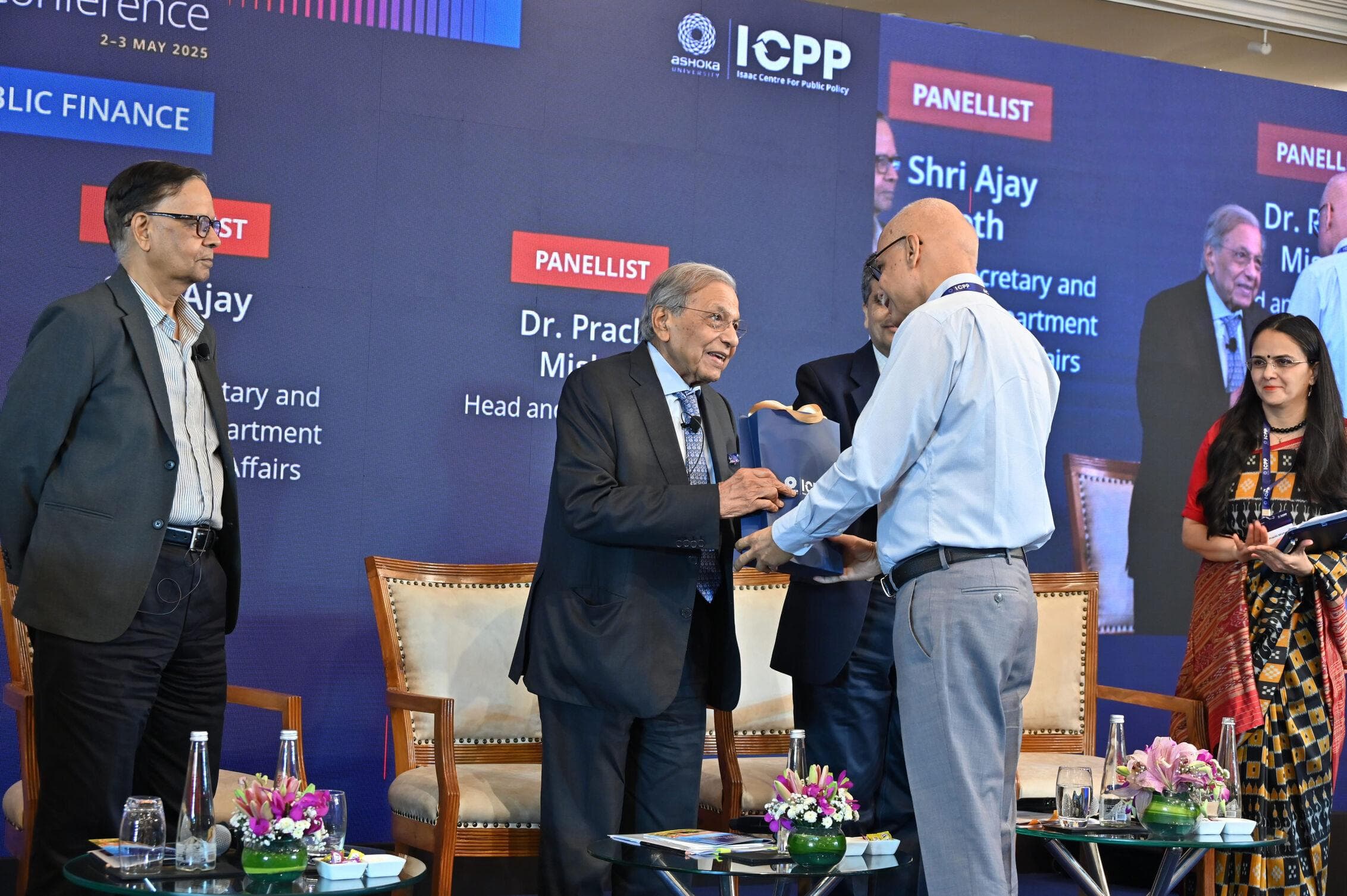
Powering the Next Decade - India's Macroeconomic Landscape Amid Global Headwinds

Speakers: Dr. Prachi Mishra ( Dean, Ashoka School of Economics and Finance (RJSEF); Director and Head, Ashoka Isaac Centre for Public Policy (ICPP); Professor of Economics, Ashoka University), Shri Vumlunmang Vualnam ( Secretary, Department of Expenditure, Ministry of Finance), Dr. Arunish Chawla ( Secretary, Department of Investment and Public Asset Management, Ministry of Finance), Shri Santanu Sengupta ( Managing Director and Chief India Economist, Goldman Sachs)

About the talk:

  • Dr. Mishra set the global context: the world is facing record-high levels of trade and policy uncertainty, though global growth has stayed surprisingly resilient because businesses are pouring investment into artificial intelligence and semiconductors, partially offsetting the drag from trade wars. 

  • Shri Vualnam addressed the fiscal picture, noting that while budget borrowings have been reduced, India imports 60% of its LPG with 90% transiting a single strait, making fiscal stress real. However, capital expenditure on highways and railways continues at budgeted levels to maintain infrastructure momentum. 

  • Dr Arunish Chawla argued that focusing on a few key areas solves multiple problems simultaneously, pointing to strong performance in pharma, electronics, engineering goods, automotive, and value-added agriculture. Public capex (on-budget and off-budget) is creating large-scale construction jobs and absorbing labour from agriculture.  

  • Shri Sengupta addressed the FDI question, arguing that net outflows partly reflect investors earning good returns, and ease of entry and exit is a positive signal for a maturing economy. He identified resilience as the central theme: India has faced three major supply shocks in six years, and if the country doubles down on resilience, FDI follows.

Regulation and the Cost of Capital

Speakers: K P Krishnan ( Member of Advisory Board, Distinguished Fellow, ICPP), Shri M. Nagaraju ( Secretary, Department of Financial Services, Ministry of Finance), Shri M. Rajeshwar Rao ( Former Deputy Governor, Reserve Bank of India), Ananth Narayan ( Former Whole Time Member, SEBI, Senior Visiting Fellow, ICPP), Dr. Harsh Vardhan ( Former Partner and Senior Advisor, Bain & Company)

About the talk:

  • Regulation Keynote Shri M. Nagaraju, Secretary, Department of Financial Services, Ministry of Finance
    Secretary Nagaraju structured the keynote around the distinction the debate often collapses: availability vs. affordability. Capital may be available, but the question is whether it is affordable for small farmers, small businesses, and rural borrowers.

  • Dr K.P. Krishnan: every regulatory choice in the financial sector (capital adequacy norms, risk weights, compliance obligations, investment mandates) carries a downstream cost that ultimately lands on the borrower. The question is not whether regulation has costs but whether those costs are calibrated with sufficient precision.

  • Shri Rajeshwar Rao: called for stronger cross-regulator coordination to prevent risk from migrating between financial segments  

  • Ananth Narayan G: equity capital is cheap in India, debt is not, a paradox created by differential taxation, mandatory EPFO/NPS allocations favouring equity, and RBI yield interventions

  • Dr Harsh Vardhan: high fixed regulatory costs reduce competition precisely in the segments where it is most needed — fintechs and smaller institutions

India and the World - Toward Frictionless Trade

Speakers: Shri Vivek Johri ( Former Chairman, Central Board of Indirect Taxes and Customs), Dr. Janmejaya Sinha ( Chairman India, Boston Consulting Group), Anup Wadhawan ( Member of Advisory Board, ICPP), Ms. Parul Vivek ( Leader, APJC Theatre – Customs and Trade, Global Tax and Customs, Cisco), Shri Vijay Singh Chauhan ( Co- Lead, International Trade Vertical, ICPP)

About the talk:

  • Shri Vivek Johri emphasised that new FTAs are partly neutralising the challenges from tariff escalation and the West Asia conflict. Logistics costs have dropped from 14% to 8%, and infrastructure improvements are visible on the ground (notably around Nhava Sheva port). The key remaining bottleneck is inefficient dispute resolution and poor inter-agency coordination at borders

  • Dr Janmejaya Sinha provided historical context on how infrastructure investments and FTAs have become priorities in a way they were not previously, arguing for less discretion and more rules-based systems in trade governance.

  • Dr Anup Wadhawan acknowledged progress in improving the business environment but flagged persistent problems: lacklustre growth in segments, joblessness, and falling foreign investment. 

  • Ms Parul Vivek argued the focus must shift to eliminating remaining invisible frictions in the trading system, with technology-driven trust building being crucial for India's 2047 ambitions.

  • Shri Vijay Singh Chauhan highlighted the significant gap between official metrics (World Bank data showing border clearance down from 37 to 3 days) and ground-level reality where traders still report much longer delays. ICPP's Logistics Cost Index currently under development will provide the rigorous data needed to move from rhetoric to targeted, measurable reform.

IMAGE GALLERY
In Pictures
gallery-1
gallery-2
gallery-3
gallery-4
gallery-5
gallery-6
gallery-7
gallery-8
gallery-9
gallery-10
gallery-11
gallery-12
MEDIA HIGHLIGHTS

In 
The 
Press 

View All
icpp-logo
As the policy wing of Ashoka University, ICPP stands at the intersection of rigour and relevance, building pathways for knowledge to converge, travel, inform, and transform.

Subscribe to our newsletter

©2024-25 Isaac Centre for Public Policy